
Works · Short story · 1839
The Fall of the House of Usher
First appeared Sep 1839 in Burton's Gentleman's Magazine
Nocturne plate · illustration (AI-generated, 2026)
Synopsis
An unnamed narrator answers a letter from Roderick Usher, a boyhood friend, and rides through a dreary autumn landscape to the family mansion, which stands above a black tarn. He finds Roderick wasted by nervous illness, his senses painfully sharp, and Roderick’s twin sister Madeline slipping toward death. When she seems to die, the two men entomb her in a vault beneath the house. A storm rises. As the narrator reads an old romance aloud to calm his friend, the sounds in the story begin to answer from somewhere inside the walls.
I know not how it was—but, with the first glimpse of the building, a sense of insufferable gloom pervaded my spirit.
Facts
- The tale first appeared in Burton’s Gentleman’s Magazine for September 1839 and entered book form in Tales of the Grotesque and Arabesque, whose first volume carries it on pages 75 to 103.[1][4]
- Tales of the Grotesque and Arabesque collected 25 stories in two volumes. Lea and Blanchard printed it ‘at our own risque and expense’, in a run the Poe Society accepts as 750 copies (the publishers had first proposed 1,750), and left the copyright with Poe. The title page says 1840, but the set probably appeared in early November 1839.[2]
- On 7 September 1839 the New York Evening Star said the tale would have been considered a chef d’oeuvre had it appeared in Blackwood’s; Bentley’s Miscellany reprinted it in August 1840.[1]
Setting
Undated; an autumn day, with the narrator arriving on horseback at dusk[3]
- the House of Usher
- a black tarn
- a vault beneath the house
Themes
Notes on dates 2 notes on disputed dates and attribution
- Date of Tales of the Grotesque and Arabesque: title page 1840, but the Poe Society says it ‘probably appeared in early November of 1839’. Shown as 1839 (year only) because ‘probably’ is not proof of the month.
- Source attributions (Hoffmann, Warren) are scholarly suggestions recorded by Mabbott; Mabbott doubts others (Pollin’s Godwin parallels). Only Hoffmann and Warren are listed, worded as suggestions.
Threads
Threads in
- Descends from E. T. A. Hoffmann, 'Das Majorat' (outside this timeline)
Margaret Alterton linked Poe’s gloomy house, a symbol of a family dying out, to Hoffmann’s story, as reported in Mabbott’s notes.[1]
- Descends from Samuel Warren, 'Thunder Struck' (Passages from the Diary of a Late Physician, 1835) (outside this timeline)
Alterton proposed it as a source for the cataleptic lady, the storm and the coffin; Mabbott records the suggestion without endorsing it.[1]
Threads out
No sourced relation from a later work on this timeline is recorded.
Contemporaries
Works on the timeline that first appeared within three years of 1839, and the other writers alive when The Fall of the House of Usher appeared (ages computed from sourced dates).
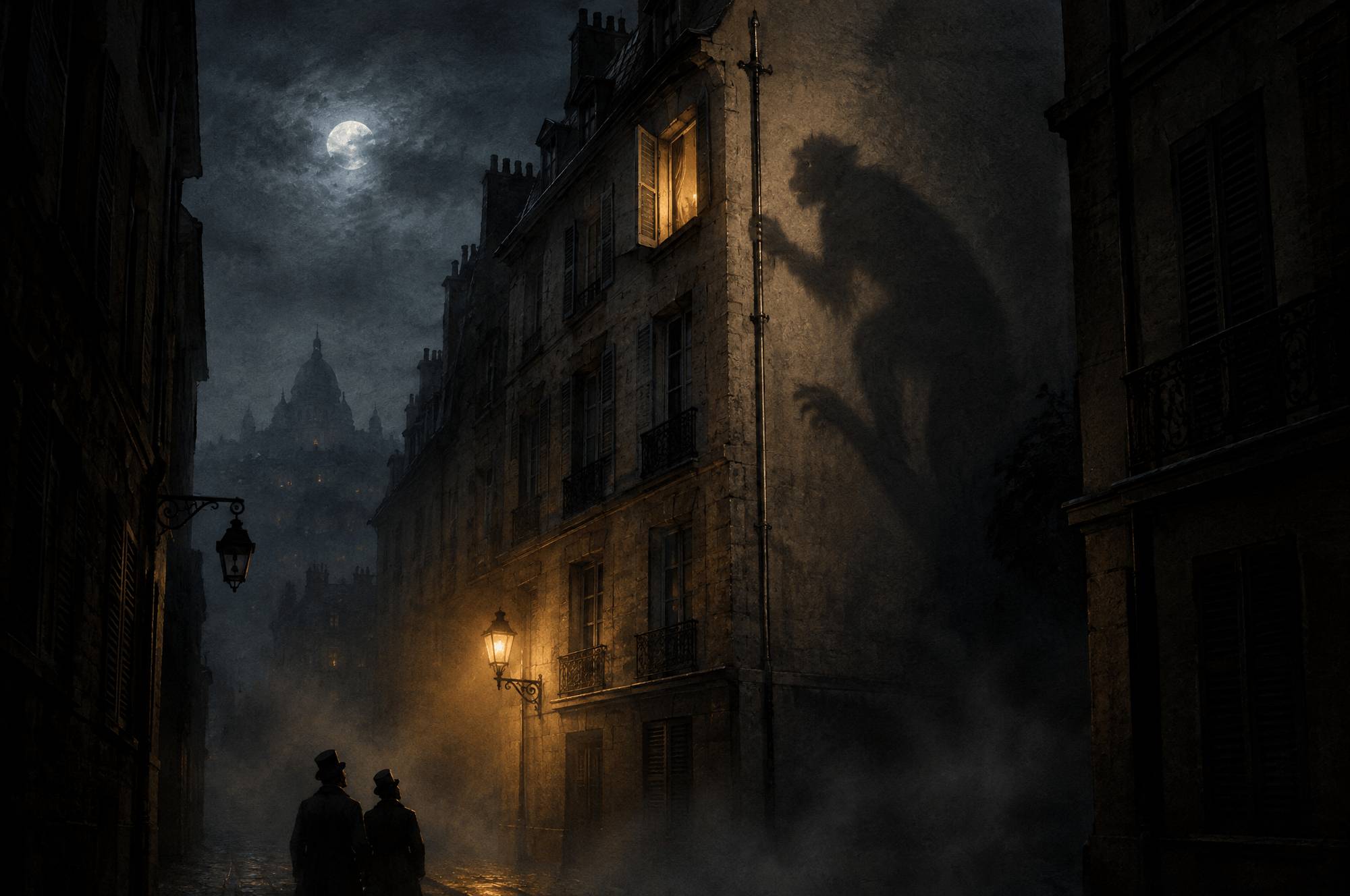
Thumbnails: Nocturne plates · illustration (AI-generated, 2026).
Alive at first appearance (Sep 1839)
Where a date is known only to the month or year, an age is given as the two values it could be.
- Mary Shelley 42
- Thomas Peckett Prest 28 to 30
- James Malcolm Rymer about 24 or 25
- Charlotte Brontë 23
- Emily Brontë 21
- Wilkie Collins 15
- Sheridan Le Fanu 25
Sources
- Mabbott, textual introduction and notes to 'The Fall of the House of Usher', Collected Works of Edgar Allan Poe vol. II (Tales and Sketches). Edgar Allan Poe Society of Baltimore. Accessed 2026-10-09.
- Tales of the Grotesque and Arabesque (1840): edition description. Edgar Allan Poe Society of Baltimore. Accessed 2026-10-09.
- The Fall of the House of Usher (Project Gutenberg ebook 932). Project Gutenberg. Accessed 2026-10-09.
- 'The Fall of the House of Usher', text from Tales of the Grotesque and Arabesque (1840), vol. I, pp. 75-103 (Text-03b). Edgar Allan Poe Society of Baltimore. Accessed 2026-10-09.