
Nocturne plate · illustration (AI-generated, 2026)
Full title: Melmoth the Wanderer: A Tale
Synopsis
In the autumn of 1816 John Melmoth, a Trinity College student, leaves Dublin for County Wicklow to attend a dying uncle. In the old house he finds a portrait dated 1646, an order to destroy it, and a mouldering manuscript he is advised not to read. It tells of an ancestor, glimpsed again over two centuries, who bargained away his soul for length of days. John then gathers further testimonies, among them a Spanish youth forced into a convent and a girl raised alone on an island, as Maturin follows the Wanderer across Europe in search of someone desperate enough to take over his bargain.
time told his awful lesson to silence alone;—the hearths were black with fuel long since consumed;—the family portraits looked as if they were the only tenants of the mansion;
Attribution and scope
Published anonymously; the title page reads ‘By the author of Bertram, &c.’.
Facts
- Maturin says in his Preface that the idea of the Wanderer came from a passage in one of his own sermons, which he quotes: would anyone present accept all that man could bestow, or earth afford, to give up the hope of salvation?[1]
- The novel was published anonymously in four volumes in 1820, issued by Archibald Constable and Company in Edinburgh and Hurst, Robinson and Co. in London, with a title page that names its author only as the author of ‘Bertram’; Maturin’s Preface is dated Dublin, 31 August 1820.[1][2]
- Maturin lived near Marsh’s Library in Dublin and was a regular visitor; its exhibition for the book’s bicentenary shows the sixteenth- and seventeenth-century printed matter he drew on to attack religious hypocrisy.[5]
- After his release from prison in 1897 Oscar Wilde, Maturin’s grandnephew by marriage, travelled in France under the name ‘Sebastian Melmoth’; Balzac’s sequel Melmoth reconcilie appeared in 1835.[3][2]
Setting
The autumn of 1816, with embedded narratives reaching back to 1646 and 1676-77[1][4]
- County Wicklow
- Dublin
- Spain
- an Indian island
- London
Themes
Notes on dates 3 notes on disputed dates and attribution
- Maturin’s birth year (1780 or 1782) is disputed between sources; see Charles Maturin’s author entry.
- Month of publication: no authoritative source gives it; the Preface is dated 31 August 1820, and only the year is shown.
- Wilde’s relationship to Maturin: Encyclopedia.com says grandnephew by marriage; some dealers say great-nephew. ‘Grandnephew by marriage’ follows Encyclopedia.com.
Threads
Threads in
- In the tradition of The Mysteries of Udolpho 1794
In the Radcliffean tradition rather than a link to Udolpho by title: Maturin’s Preface reports a friend’s objection that the Spaniard’s Tale revives the horrors of ‘Radcliffe-Romance’, and defends it as drawing convent misery from petty daily torments.[1]
- Descends from Faust and the Wandering Jew legends (outside this timeline)
Encyclopedia.com says the novel draws on the Faust and Wandering Jew legends in following a seventeenth-century scholar who trades his soul for extended life.[3]
Threads out
- A critic's reading links it to Dorian Gray 1890
A critic’s reading, not a statement by Wilde: a Dublin Review of Books essay finds Maturin’s legacy in the work of his grand-nephew Wilde, ‘particularly’ in Dorian Gray, and notes that after prison Wilde took the name Melmoth.[6]
Contemporaries
Works on the timeline that first appeared within three years of 1820, and the other writers alive when Melmoth the Wanderer appeared (ages computed from sourced dates).

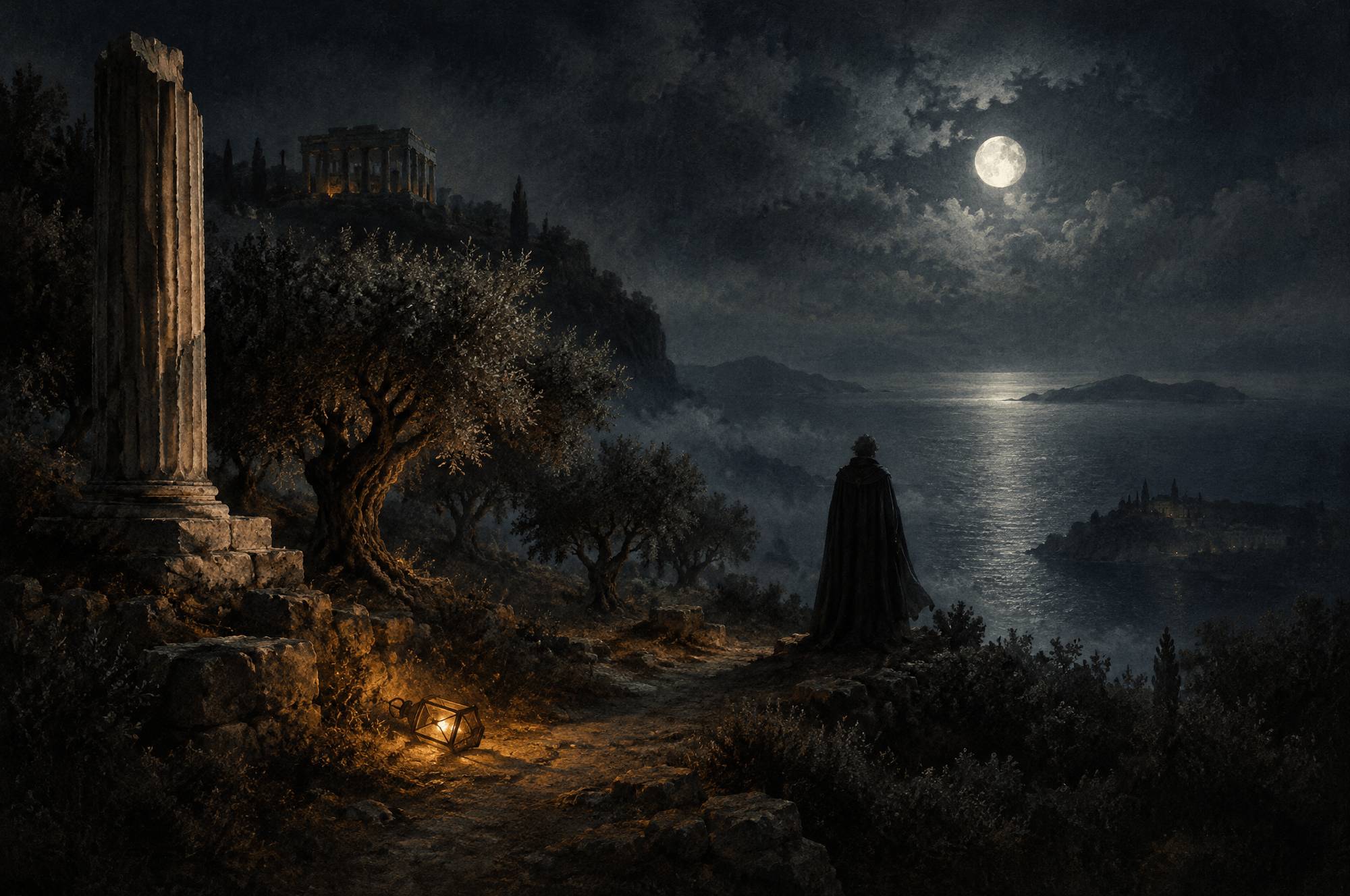
Thumbnails: Nocturne plates · illustration (AI-generated, 2026).
Alive at first appearance (1820)
Where a date is known only to the month or year, an age is given as the two values it could be.
- Ann Radcliffe 55 or 56
- Mary Shelley 22 or 23
- John Polidori 24 or 25
- Edgar Allan Poe 10 or 11
- Thomas Peckett Prest 9 to 11
- James Malcolm Rymer about 5 or 6
- Charlotte Brontë 3 or 4
- Emily Brontë 1 or 2
- Sheridan Le Fanu 5 or 6
Sources
- Melmoth the Wanderer, Vol. 1 (Gutenberg ebook 53685; 1820 Constable/Hurst Robinson title page, Maturin's Preface dated Dublin 31 August 1820). Project Gutenberg. Accessed 2026-10-09.
- Maturin, Charles R (entry). The Encyclopedia of Science Fiction (SFE). Accessed 2026-10-09.
- Maturin, Charles Robert (1780-1824). Encyclopedia.com (Gale). Accessed 2026-10-09.
- Melmoth the Wanderer, Vol. 3 (Gutenberg ebook 53687; Immalee/Isidora narrative). Project Gutenberg. Accessed 2026-10-09.
- 'Ragged, Livid & On Fire': the Wanderings of Melmoth at 200 (online exhibition). Marsh's Library, Dublin. Accessed 2026-10-09.
- A Literary Terrorist (on Maturin's Melmoth the Wanderer and its legacy). Dublin Review of Books. Accessed 2026-10-09.