
Nocturne plate · illustration (AI-generated, 2026)
Full title: Strange Case of Dr Jekyll and Mr Hyde
Synopsis
The lawyer Gabriel Utterson is troubled by the will of his friend Dr Henry Jekyll, which leaves everything to a stranger named Edward Hyde. Hyde is small, pale and repellent, and the first thing Utterson hears of him is that he trampled a child in the street and bought the family off with a cheque in Jekyll’s name. When Hyde is later wanted for murder, Utterson goes looking for the hold he has over a respectable man. Two written documents, one from a dead colleague and one from Jekyll himself, close the book. They describe an experiment in a London laboratory and what it costs a man to divide himself.
that man is not truly one, but truly two. I say two, because the state of my own knowledge does not pass beyond that point.
Facts
- Stevenson said the tale began in a dream: after two days of racking his brains for a plot he dreamed the window scene and a scene in which Hyde, pursued, takes the powder and changes before his pursuers. In ‘A Chapter on Dreams’ he wrote that what the dream gave him was ‘the matter of three scenes, and the central idea of a voluntary change becoming involuntary’, and that the rest was made awake.[6]
- The American publisher came first. Scribner’s issued its authorized New York edition on 5 January 1886, about four days before Longmans in London, whose edition had been meant for Christmas 1885 and was held back until the new year.[1][2][3]
- At one shilling the book belonged to the ‘shilling shocker’ trade. A bookseller’s catalogue note records that it sold slowly until a favourable review in The Times, then about 40,000 copies in its first six months.[4][2]
Setting
Contemporary London; the year is masked in the text as 18—[5]
- London
- Soho
- Cavendish Square
Themes
Notes on dates 2 notes on disputed dates and attribution
- Publication dates: The First Edition (a dealer) cites McKay 346 and Prideaux 17 for Scribner’s, New York, on 5 January 1886 and Longmans, London, on 9 January 1886; Bonhams and Bauman (citing Beinecke and Prideaux) say only that Longmans’ publication was held to January 1886. No publisher’s ledger or Publishers’ Circular notice was seen.
- The Times review (25 January 1886 per Wikipedia) and ‘close to 40,000’ copies in six months are repeated by Bonhams but no sales ledger or the notice itself was seen; the sales figure is given as a catalogue note.
Threads
Threads in
No sourced relation to an earlier work is recorded.
Threads out
No sourced relation from a later work on this timeline is recorded.
Contemporaries
Works on the timeline that first appeared within three years of 1886, and the other writers alive when Jekyll and Hyde appeared (ages computed from sourced dates).
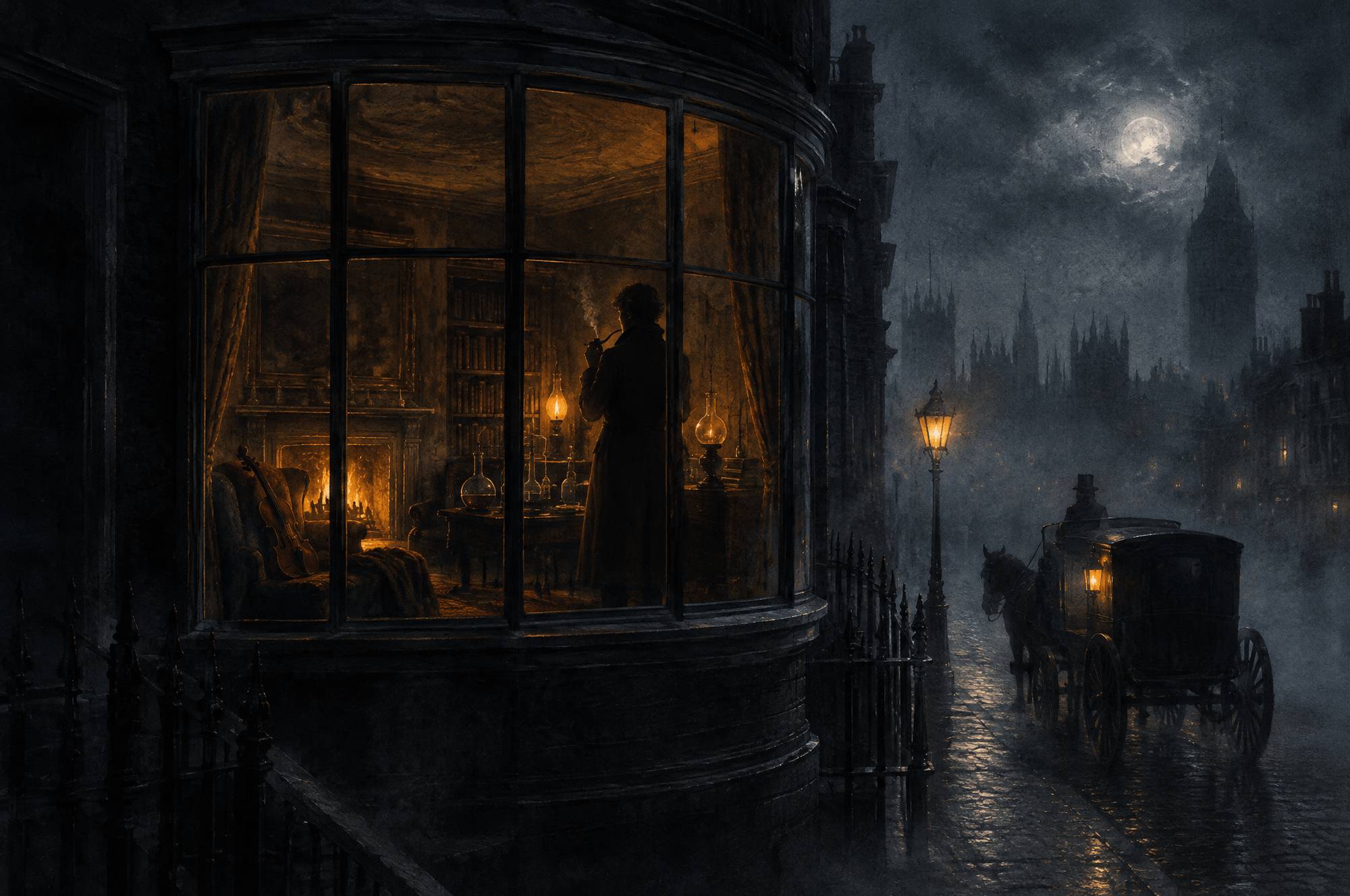
Thumbnails: Nocturne plates · illustration (AI-generated, 2026).
Alive at first appearance (5 Jan 1886)
Sources
- Strange Case of Dr Jekyll and Mr Hyde, first edition listing (cites McKay 346 and 348, Prideaux 17, Balfour's Life); dealer bibliographic description. The First Edition Rare Books. Accessed 2026-10-09.
- Stevenson, Strange Case of Dr Jekyll and Mr Hyde, Longman 1885 corrected in ink to 1886 (lot 312, 5 Dec 2019); auction catalogue note citing Beinecke and Prideaux. Bonhams. Accessed 2026-10-09.
- Strange Case of Dr. Jekyll and Mr. Hyde, London: Longmans, Green, 1886 (cites Prideaux 17, Balfour's Life ii:14); dealer description. Bauman Rare Books. Accessed 2026-10-09.
- Strange Case of Dr Jekyll and Mr Hyde (Cambridge Literature edition), book description. Cambridge University Press. Accessed 2026-10-09.
- The Strange Case of Dr. Jekyll and Mr. Hyde (ebook 43). Project Gutenberg. Accessed 2026-10-09.
- A Chapter on Dreams, in Across the Plains (ebook 614). Project Gutenberg. Accessed 2026-10-09.