
Works · Story canon · 1887
Sherlock Holmes
First appeared Nov 1887 in one issue of Beeton's Christmas Annual
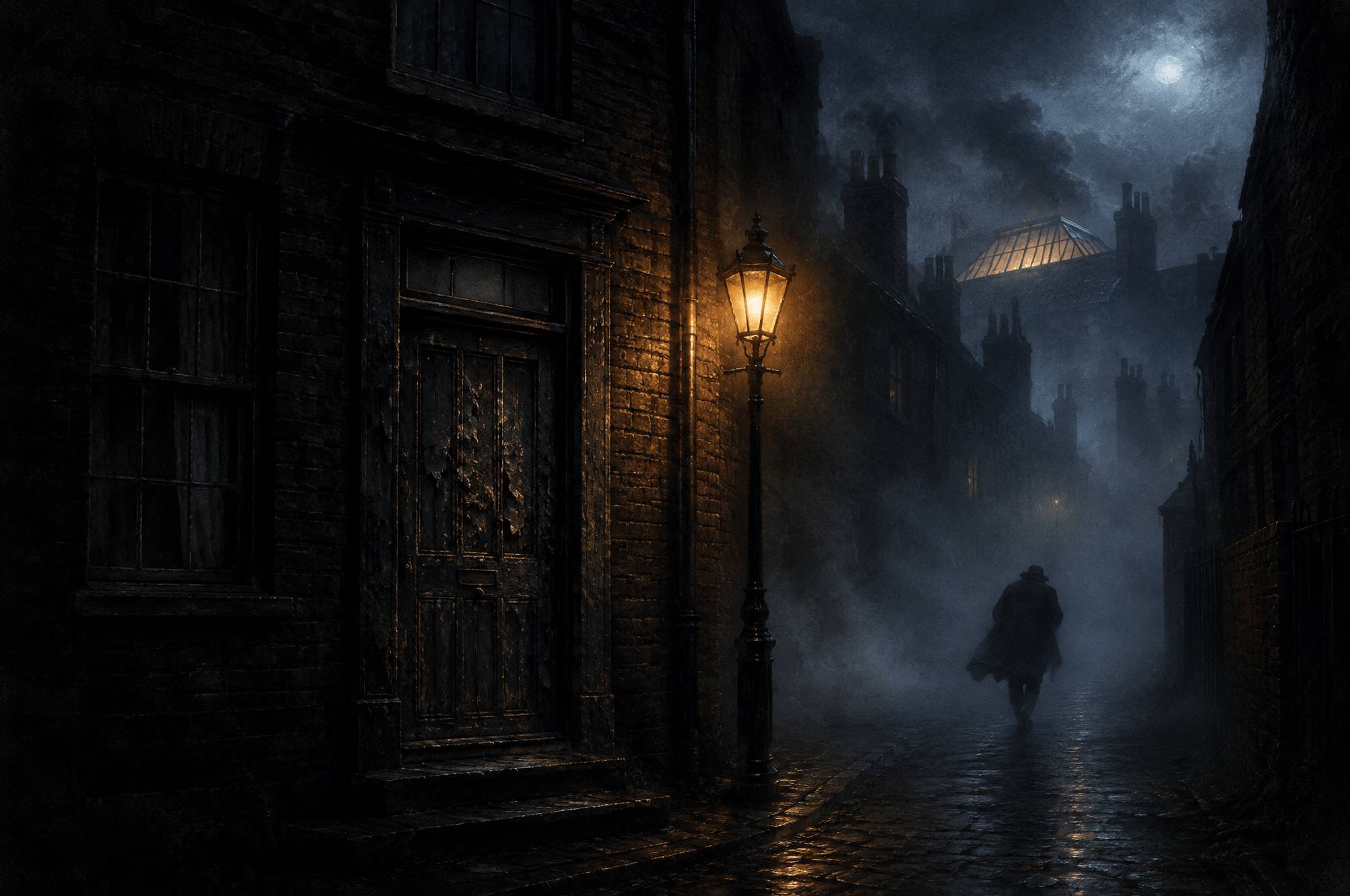
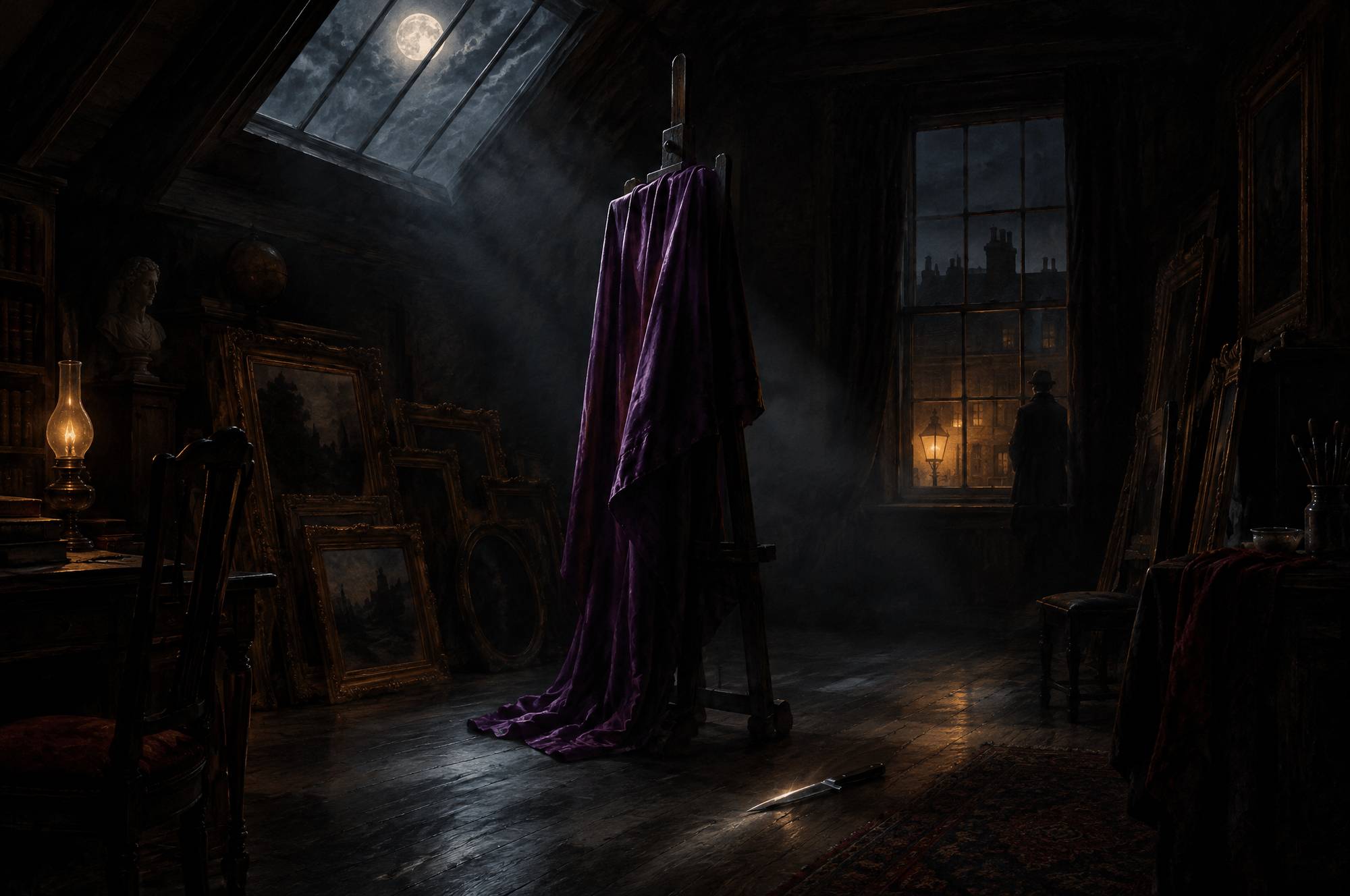
Nocturne plate · illustration (AI-generated, 2026)
Full title: The Sherlock Holmes stories (the canon, 1887 to 1927)
Synopsis
In Baker Street, London, the consulting detective Sherlock Holmes takes the cases that baffle Scotland Yard, and his friend Dr John Watson, an army surgeon invalided home from Afghanistan, writes them up. Holmes reads a stranger’s trade from a stained cuff, follows a footprint through the fog and treats a crime as a problem in evidence rather than in feeling. Across forty years of stories he meets blackmailers, forgers, a criminal professor and enemies from the empire’s far corners. His apparent death in 1893 and his return ten years later are among the best-known interruptions in popular fiction.
“No doubt you think that you are complimenting me in comparing me to Dupin,” he observed. “Now, in my opinion, Dupin was a very inferior fellow.
Attribution and scope
Treated as one entry for the whole canon of novels and short stories; the Hound of the Baskervilles also has its own entry.
This entry also has a part with its own page: The Hound of the Baskervilles (1901).
Facts
- Holmes sneers at his fictional predecessors in the very first story. When Watson compares him to Poe’s Dupin, he answers that ‘Dupin was a very inferior fellow’, and of Gaboriau’s Lecoq he says ‘Lecoq was a miserable bungler’. Doyle himself said in 1892 that ‘the best detective in fiction is Edgar Allan Poe’s Monsieur Dupin; then Monsieur Le Cocq, Gaboriau’s hero.’[12][13]
- The Strand run began in July 1891 with ‘A Scandal in Bohemia’, illustrated by Sidney Paget, whose pictures defined Holmes’s look: ten for that first story, sixty for the Strand serial of The Hound of the Baskervilles.[5][14]
- Doyle killed Holmes in ‘The Final Problem’ (Strand, December 1893). Popular accounts say about 20,000 readers cancelled their Strand subscriptions, but a Trinity College Dublin scholar presents that figure as a report and finds no evidence for the story that London clerks wore black armbands.[6][15]
- The Arthur Conan Doyle Encyclopedia numbers ‘Shoscombe Old Place’ (Liberty, 5 March 1927; Strand, April 1927) as the 62nd Holmes story in publication order and lists it last in the Strand, about forty years after Holmes first appeared in Beeton’s Christmas Annual.[9][1][16]
Setting
Victorian and Edwardian London, centred on 221B Baker Street; Watson first appears as an army doctor back from Afghanistan[12]
- London
- Baker Street
- Dartmoor
- Afghanistan
Themes
Notes on dates 3 notes on disputed dates and attribution
- Date of A Study in Scarlet: the Arthur Conan Doyle Encyclopedia shows ‘Beeton’s Christmas Annual (21 november 1887, title page)’. Shown as November 1887 because a title-page date does not prove the day of issue.
- Last story published: the Encyclopedia lists Shoscombe last in the Strand and numbers it 62nd; the Case-Book order (Shoscombe 11th, Colourman 12th) is not publication order.
- The first printing of ‘The Final Problem’ may be a US newspaper appearance on 26 November 1893, before the Strand’s December 1893 number; the Strand date is the anchor.
Threads
Threads in
- Descends from Murders in the Rue Morgue 1841
Doyle named Poe’s C. Auguste Dupin as the best detective in fiction in 1892, and Watson compares Holmes to Dupin in A Study in Scarlet.[13][12]
- Descends from Gaboriau's Monsieur Lecoq (outside this timeline)
Doyle ranked Gaboriau’s Lecoq second among fictional detectives (1892), and A Study in Scarlet has Holmes and Watson discuss Lecoq by name.[13][12]
Threads out
- Shares an origin with Dorian Gray 1890
Dorian Gray and The Sign of the Four were both commissioned by J. M. Stoddart for Lippincott’s at the same dinner on or about 30 August 1889.[4][17]
Contemporaries
Works on the timeline that first appeared within three years of 1887, and the other writers alive when Sherlock Holmes appeared (ages computed from sourced dates).
-
-
-
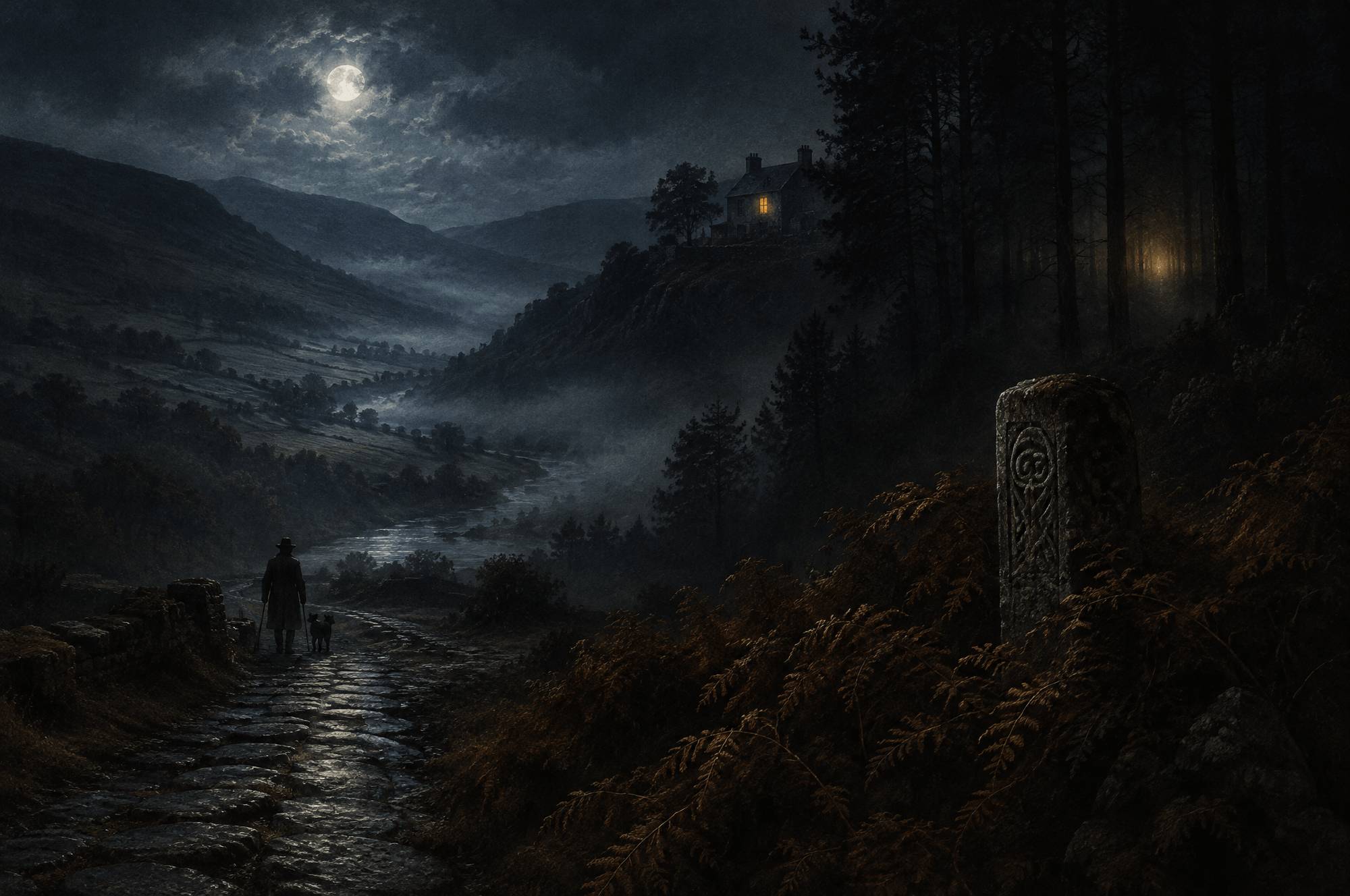
Thumbnails: Nocturne plates · illustration (AI-generated, 2026).
Alive at first appearance (Nov 1887)
Where a date is known only to the month or year, an age is given as the two values it could be.
- Wilkie Collins 63
- Robert Louis Stevenson 36 or 37
- Oscar Wilde 33
- Arthur Machen 24
- H. G. Wells 21
- Richard Marsh 30
- Bram Stoker 39 or 40
- Henry James 44
- Joseph Conrad 29
- Gaston Leroux 19
Sources
- A Study in Scarlet, Arthur Conan Doyle Encyclopedia. Arthur Conan Doyle Encyclopedia. Accessed 2026-10-09.
- A Sir Arthur Conan Doyle Chronology. The Victorian Web. Accessed 2026-10-09.
- The Sign of the Four, Arthur Conan Doyle Encyclopedia. Arthur Conan Doyle Encyclopedia. Accessed 2026-10-09.
- Borrowed Sins (account of the Lippincott dinner, quoting Doyle's diary and Stoddart's letter of 30 August 1889). Arthur Conan Doyle Encyclopedia. Accessed 2026-10-09.
- A Scandal in Bohemia, Arthur Conan Doyle Encyclopedia. Arthur Conan Doyle Encyclopedia. Accessed 2026-10-09.
- The Final Problem, Arthur Conan Doyle Encyclopedia. Arthur Conan Doyle Encyclopedia. Accessed 2026-10-09.
- The Adventure of the Empty House, Arthur Conan Doyle Encyclopedia. Arthur Conan Doyle Encyclopedia. Accessed 2026-10-09.
- The Valley of Fear, Arthur Conan Doyle Encyclopedia. Arthur Conan Doyle Encyclopedia. Accessed 2026-10-09.
- Shoscombe Old Place, Arthur Conan Doyle Encyclopedia. Arthur Conan Doyle Encyclopedia. Accessed 2026-10-09.
- The Case-Book of Sherlock Holmes, Arthur Conan Doyle Encyclopedia. Arthur Conan Doyle Encyclopedia. Accessed 2026-10-09.
- The Adventure of the Retired Colourman, Arthur Conan Doyle Encyclopedia. Arthur Conan Doyle Encyclopedia. Accessed 2026-10-09.
- A Study in Scarlet (ebook 244). Project Gutenberg. Accessed 2026-10-09.
- Edgar Allan Poe, Arthur Conan Doyle Encyclopedia (collects Doyle's statements on Poe and Dupin, 1892 to 1930). Arthur Conan Doyle Encyclopedia. Accessed 2026-10-09.
- The Hound of the Baskervilles, Arthur Conan Doyle Encyclopedia. Arthur Conan Doyle Encyclopedia. Accessed 2026-10-09.
- Article by Clare Clarke (Trinity College Dublin) on the Holmes stories and Victorian detective fiction. Scroll.in. Accessed 2026-10-09.
- The Strand Magazine, Arthur Conan Doyle Encyclopedia. Arthur Conan Doyle Encyclopedia. Accessed 2026-10-09.
- Lippincott's Monthly Magazine, Arthur Conan Doyle Encyclopedia. Arthur Conan Doyle Encyclopedia. Accessed 2026-10-09.