
Nocturne plate · illustration (AI-generated, 2026)
Full title: The Monk: A Romance
Synopsis
In Madrid the Capuchin preacher Ambrosio draws crowds who call him a saint, a man who has never been tempted. Then a young novice named Rosario joins the abbey, and the abbot’s pride begins to give way. Once he has taken the first step, Ambrosio is led through lust, murder and the black arts, and fixes his desire on the innocent Antonia, whose mother stands between them. Lewis braids this fall with the story of Raymond and his lost love Agnes, and with a ghost, the Bleeding Nun, who walks a German castle at night. Behind everything stands the Inquisition, ready to try the abbot’s crimes.
As I listened to the mournful hollow sound, and heard it die away in the wind, I felt a sudden chillness spread itself over my body. I shuddered without knowing wherefore;
Attribution and scope
First edition (March 1796) anonymous; the second edition (October 1796) named ‘M. G. Lewis, Esq. M.P.’ on the title page. The fourth edition (1798) was expurgated and retitled ‘Ambrosio, or The Monk’.
Facts
- Lewis wrote The Monk at The Hague, where he was an attache at the British embassy; on 23 September 1794 he asked his mother what she thought of his having written, ‘in the space of ten weeks’, a romance of between three and four hundred octavo pages. His verse Preface is signed ‘Hague, Oct. 28, 1794’, and he says he has scarcely seen his twentieth year.[1][3]
- The first edition appeared anonymously in March 1796 in three duodecimo volumes from John Bell of Oxford Street at nine shillings; a second edition in October 1796 carried Lewis’s name and the letters M.P., because he had been elected to Parliament.[1][2]
- Samuel Taylor Coleridge’s review in the Critical Review (February 1797) called the book obscene and immoral while granting it was ‘the offspring of no common genius’; Lewis later had to issue an expurgated edition, the fourth, retitled Ambrosio, or The Monk.[1][4][2]
- In his Advertisement Lewis lists his borrowings: the first idea came from the story of the Santon Barsisa in The Guardian, the Bleeding Nun from a legend still credited in Germany, and The Water-King from a fragment of a Danish ballad.[3][4]
Setting
Unspecified; a Catholic Spain of Capuchins and the Inquisition[3]
- Madrid
- the Capuchin abbey
- Strasbourg
- the castle of Lindenberg in Germany
Themes
Notes on dates 3 notes on disputed dates and attribution
- Year of first publication: the DNB says the novel appeared ‘in the summer of 1795’; Encyclopedia.com entries give 1795 or 1796. Summers says some scholars wrongly date it to 1795 and gives March 1796 with Bell’s advertisement that month. March 1796 is shown.
- Prosecution: the DNB says the attorney-general moved for an injunction; the McGill article, quoting Lewis’s 1818 obituary, says prosecution was only ‘talked of’. Neither is stated as fact.
- Composition: ‘ten weeks’ is Lewis’s own claim in his letter of 23 September 1794 (via Summers) and is presented as his claim.
Threads
Threads in
- Descends from The Mysteries of Udolpho 1794
The Dictionary of National Biography says Lewis was induced to go on with The Monk by his interest in Udolpho, and Summers reports he read it just before and after reaching The Hague in 1794, though he found its landscape passages dull.[4][1]
- Descends from The Guardian no. 148 (the Santon Barsisa story) (outside this timeline)
Lewis’s own Advertisement says the first idea of the romance was suggested by the story of the Santon Barsisa in The Guardian, and the Dictionary of National Biography gives the number as 148.[3][4]
Threads out
No sourced relation from a later work on this timeline is recorded.
Contemporaries
Works on the timeline that first appeared within three years of 1796, and the other writers alive when The Monk appeared (ages computed from sourced dates).
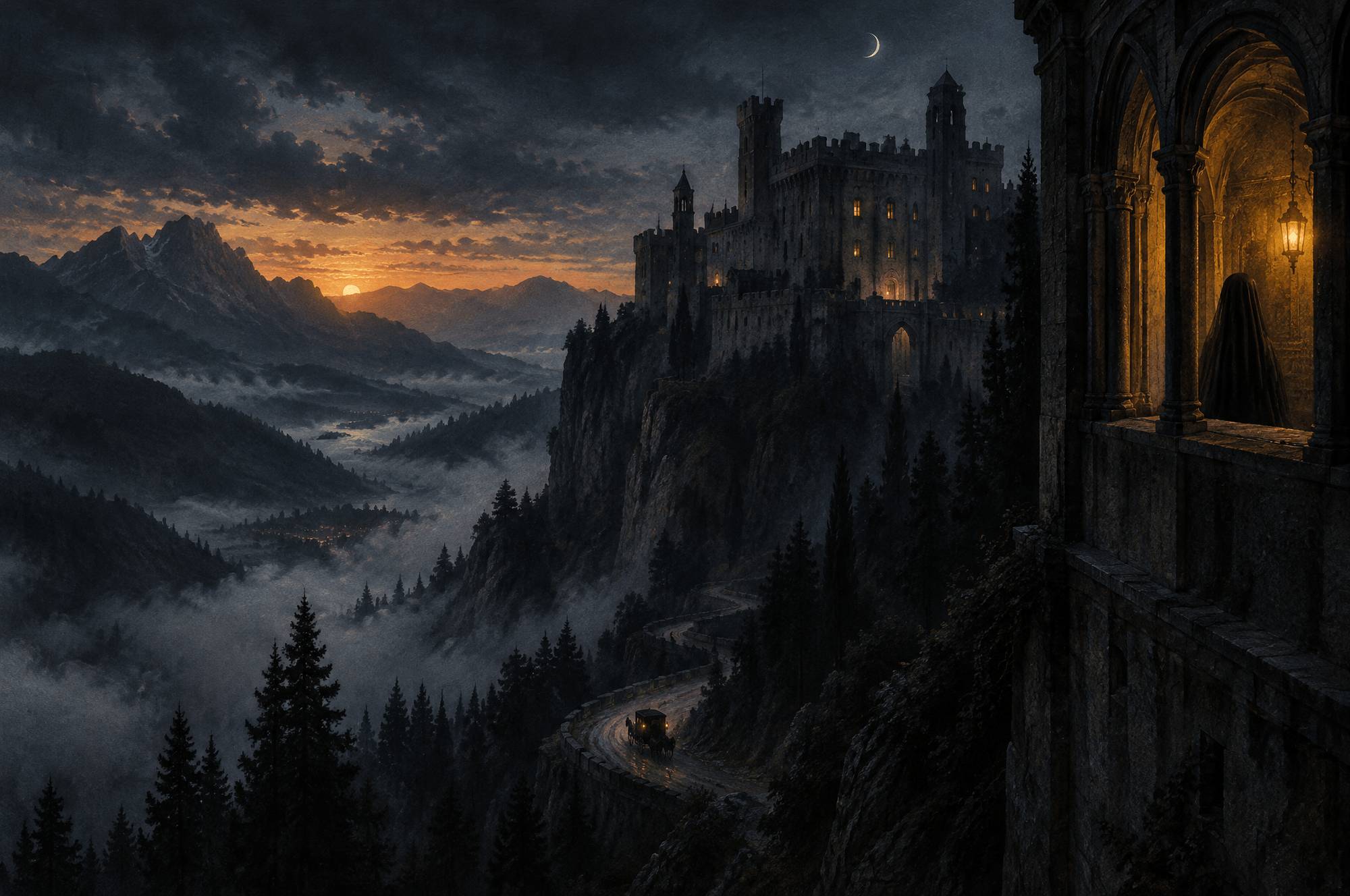
Thumbnails: Nocturne plates · illustration (AI-generated, 2026).
Alive at first appearance (Mar 1796)
- Horace Walpole 78
- Ann Radcliffe 31
- John Polidori under a year old
- Charles Maturin 13 to 16
Sources
- Lewis, Matthew Gregory (1775-1818) (includes Montague Summers, The Gothic Quest, extracts; quotes Lewis's letters of 18 May and 23 September 1794). Encyclopedia.com (Gale / Thomson Gale). Accessed 2026-10-09.
- The Great Monk Controversy: Religious, Moral and Literary Criticism on The Monk, 1796-98 (undergraduate review article citing Parreaux, Peck, Macdonald and Scherf). McGill Channel Undergraduate Review. Accessed 2026-10-09. Pointer source (tier 3).
- The Monk: A Romance, by M. G. Lewis, Esq. M.P. (Gutenberg ebook 601; includes Lewis's verse Preface dated Hague, Oct. 28, 1794, and his Advertisement). Project Gutenberg. Accessed 2026-10-09.
- Lewis, Matthew Gregory, Dictionary of National Biography 1885-1900. Dictionary of National Biography, via Wikisource. Accessed 2026-10-09.