
Nocturne plate · illustration (AI-generated, 2026)
Full title: Frankenstein; or, The Modern Prometheus
Synopsis
Robert Walton, an English captain pushing north toward the Pole, writes to his sister about the half-frozen stranger his crew has pulled from the ice: Victor Frankenstein, who is chasing something across the sea. Victor tells his story. A Genevan student at Ingolstadt, he assembles a living creature from dead matter, then runs from what he has made. Abandoned, the creature teaches himself language and grief from a hiding place beside a cottage, and asks his maker for a companion. When Victor refuses, the creature turns on the people Victor loves. Letters nest inside narratives, and the monster argues better than his maker.
by the glimmer of the half-extinguished light, I saw the dull yellow eye of the creature open; it breathed hard, and a convulsive motion agitated its limbs.
Attribution and scope
1818 first edition anonymous, with an unsigned Preface by Percy Bysshe Shelley and a dedication to William Godwin; readers often took Percy for the author. Mary Shelley’s name appeared on later editions (the third edition of 1831 carries her new Introduction, signed M. W. S.).
Facts
- The first edition appeared in January 1818 in three volumes from the small London firm of Lackington, Hughes, Harding, Mavor & Jones, in a run of 500 copies and without the author’s name.[2][3][4][1]
- The book grew from a ghost-story pact in the wet summer of 1816 near Lake Geneva: after reading German ghost stories in French translation, Byron proposed, ‘We will each write a ghost story’. Polidori’s diary shows the stories were already begun by 17 June 1816.[5][8][9]
- Reviews of the anonymous 1818 edition were split: the novelist Walter Scott praised its vigor and originality, while other critics condemned ‘the tissue of horrible and disgusting absurdity’ in the book.[10]
- For the 1831 edition, issued by Colburn and Bentley as a Standard Novel, Mary Shelley revised the text and wrote the Introduction that tells of the ghost-story contest and of the waking dream that began with the words ‘It was on a dreary night of November’; the third edition was the first illustrated edition, with an engraved frontispiece by W. Chevalier after Theodor von Holst.[5][6][7]
Setting
The eighteenth century; the letters are dated only ‘17—‘[1]
- St. Petersburgh
- Archangel
- Geneva
- Ingolstadt
- Orkney
- the Arctic
Themes
Notes on dates 3 notes on disputed dates and attribution
- Which text is Gutenberg #84? It is not cleanly either edition (it has Elizabeth as a Milanese nobleman’s daughter, an 1831 reading, but no 1831 Introduction). The quote was therefore taken from #41445, the 1818 text.
- Day of first publication: catalogues give 1 January 1818 and the Notre Dame library gives only 1818; no bibliography-backed source gives the day, so January 1818 is shown.
- 1831 edition: dealers and Wikipedia say October (Wikipedia 31 October) but no authoritative source gives the month; only 1831 is shown. Whether it was one volume or two is reported differently by dealers; one volume is recorded.
Threads
Threads in
- Descends from Fantasmagoriana (German ghost stories in French translation) (outside this timeline)
Mary Shelley says volumes of German ghost stories translated into French fell into their hands and preceded Byron’s proposal; Rossetti and the 1819 Vampyre name the book as Fantasmagoriana/Phantasmagoriana.[5][8][11]
Threads out
- A critic's reading links it to Island of Doctor Moreau 1896
Roger Bowen (Studies in the Novel, 1976, as summarised by Gale) argues that Moreau descends from Mary Shelley’s Victor Frankenstein, with Wells updating the myth for the Darwinian age by replacing galvanism with biological science.[12]
- Shares an origin with The Vampyre 1819
Both grew from the ghost-story contest proposed by Byron at Cologny in June 1816; the 1819 printing’s ‘Extract of a Letter from Geneva’ says the tales were undertaken by Lord B., the physician, and Miss M. W. Godwin, with a note that her tale was since published as Frankenstein.[11][8][5]
Contemporaries
Works on the timeline that first appeared within three years of 1818, and the other writers alive when Frankenstein appeared (ages computed from sourced dates).
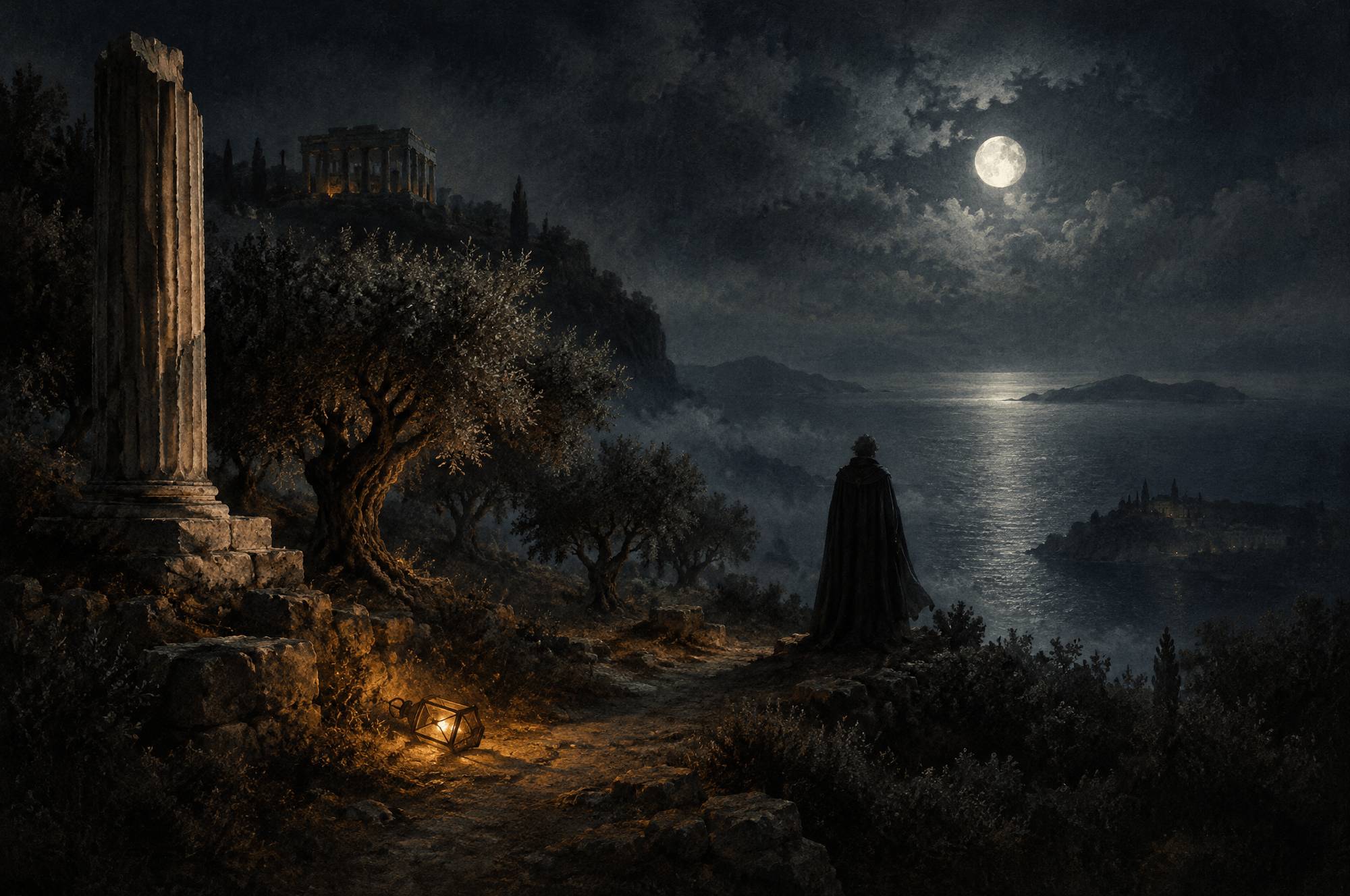
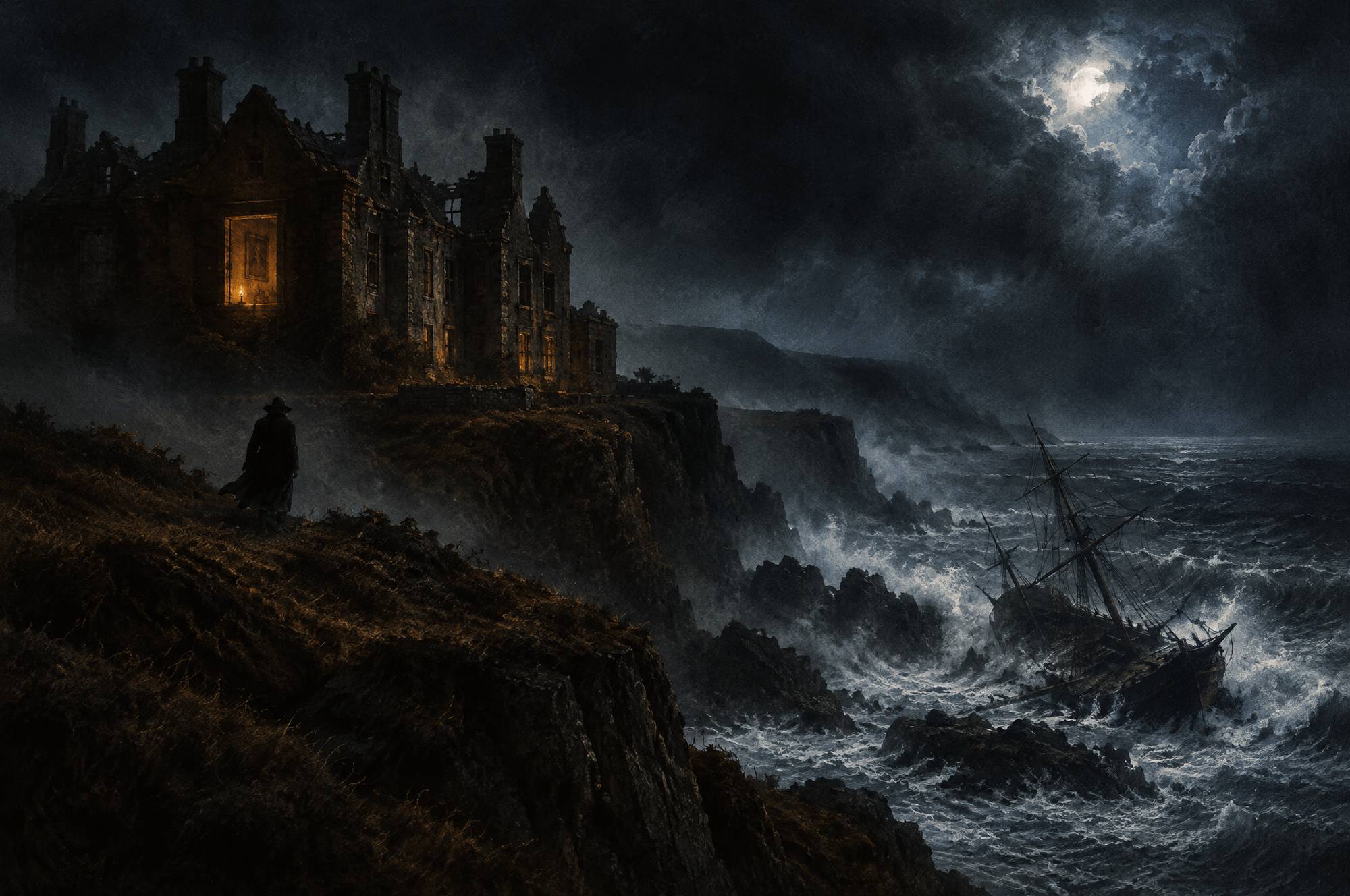
Thumbnails: Nocturne plates · illustration (AI-generated, 2026).
Alive at first appearance (Jan 1818)
Where a date is known only to the month or year, an age is given as the two values it could be.
- Ann Radcliffe 53
- Matthew Lewis 42
- John Polidori 22
- Charles Maturin 35 to 38
- Edgar Allan Poe 8 or 9
- Thomas Peckett Prest 7 to 9
- James Malcolm Rymer about 3 or 4
- Charlotte Brontë 1
- Sheridan Le Fanu 3
Sources
- Frankenstein; or, The Modern Prometheus, 1818 text in three volumes (Gutenberg ebook 41445; transcribed from a photo-reprint of the 1818 edition). Project Gutenberg. Accessed 2026-10-09.
- Recent acquisition: First edition Frankenstein (1818). University of Notre Dame, Nanovic Institute / Hesburgh Libraries. Accessed 2026-10-09.
- Shelley, Frankenstein, first edition 1818 (auction lot description). Christie's. Accessed 2026-10-09. Pointer source (tier 3).
- Frankenstein; Or, The Modern Prometheus, first edition (dealer description). Raptis Rare Books. Accessed 2026-10-09. Pointer source (tier 3).
- Frankenstein; or, The Modern Prometheus, 1831 text with the author's new Introduction (Gutenberg ebook 42324; Colburn & Bentley, Standard Novels). Project Gutenberg. Accessed 2026-10-09.
- Shelley, Frankenstein; or The Modern Prometheus, London: Henry Colburn and Richard Bentley, 1831 (auction lot). Bonhams. Accessed 2026-10-09. Pointer source (tier 3).
- Frontispiece image of Frankenstein, 1831 (von Holst, engraved by Chevalier). University of Otago Library (OUR Heritage). Accessed 2026-10-09.
- The Diary of Dr. John William Polidori, 1816, ed. William Michael Rossetti (1911); editor's Introduction reprints Polidori's letter to Colburn and 1821 press reports, with the diary entry for 17 June 1816 (Gutenberg ebook 55017). Project Gutenberg (Elkin Mathews, 1911 edition). Accessed 2026-10-09.
- The Birth of Frankenstein (exhibition), Villa Diodati panel. U.S. National Library of Medicine. Accessed 2026-10-09.
- The Birth of Frankenstein (exhibition). U.S. National Library of Medicine. Accessed 2026-10-09.
- The Vampyre; a Tale, by John William Polidori (Gutenberg ebook 6087; the 1819 book printing for Sherwood, Neely and Jones, with the 'Extract of a Letter from Geneva' and Introduction). Project Gutenberg. Accessed 2026-10-09.
- The Island of Doctor Moreau (Gale 'Novels for Students' entry, citing Philmus, Bowen, Bergonzi). Encyclopedia.com / Gale. Accessed 2026-10-09.