
Works · Novel · 1901
The Hound of the Baskervilles
First appeared Aug 1901 – Apr 1902 in The Strand Magazine
Nocturne plate · illustration (AI-generated, 2026)
Synopsis
Dr James Mortimer calls on Sherlock Holmes in Baker Street with an old family manuscript about a spectral hound said to have hunted the Baskervilles of Devon since the seventeenth century. His friend Sir Charles Baskerville has just been found dead on his own estate, and the heir, Sir Henry, has come from Canada to take up Baskerville Hall. Holmes, claiming other business in London, sends Dr Watson to Dartmoor to watch over Sir Henry and report. Watson finds fog, a convict loose on the moor, a mire that swallows ponies and neighbours with reasons of their own. The question is whether the legend is a story or a method.
“A man’s or a woman’s?” Dr. Mortimer looked strangely at us for an instant, and his voice sank almost to a whisper as he answered. “Mr. Holmes, they were the footprints of a gigantic hound!”
Attribution and scope
Part of the Sherlock Holmes canon (see sherlock-holmes).
Part of Sherlock Holmes, which has its own entry on the timeline.
Facts
- Doyle dedicated the book to his friend Fletcher Robinson: ‘It was to your account of a West-Country legend that this tale owes its inception.’[3]
- The Strand serial ran in nine monthly numbers from August 1901 to April 1902 with 60 illustrations by Sidney Paget; the Newnes book followed on 25 March 1902 with 16.[1][2]
- The novel was written after ‘The Final Problem’ (December 1893) had apparently killed Holmes, but is set in 1889, before that story’s events; his return in ‘The Empty House’ came in October 1903.[1][4][5]
Setting
1889 (per the Arthur Conan Doyle Encyclopedia), before ‘The Final Problem’[1][3]
- Dartmoor
- Baskerville Hall
- Grimpen Mire
- London
Themes
Notes on dates 1 note on disputed dates and attribution
- The novel was written after ‘The Final Problem’ (1893) but is set in 1889, before that story; the 1889 setting rests on the Arthur Conan Doyle Encyclopedia summary (the Gutenberg text does not state the year).
Threads
Threads in
- Descends from a West-Country (Dartmoor) hound legend told to Doyle by Fletcher Robinson (outside this timeline)
Doyle’s own dedication credits Robinson’s account of a West-Country legend with the book’s inception.[3]
Threads out
No sourced relation from a later work on this timeline is recorded.
Contemporaries
Works on the timeline that first appeared within three years of 1901, and the other writers alive when The Hound of the Baskervilles appeared (ages computed from sourced dates).
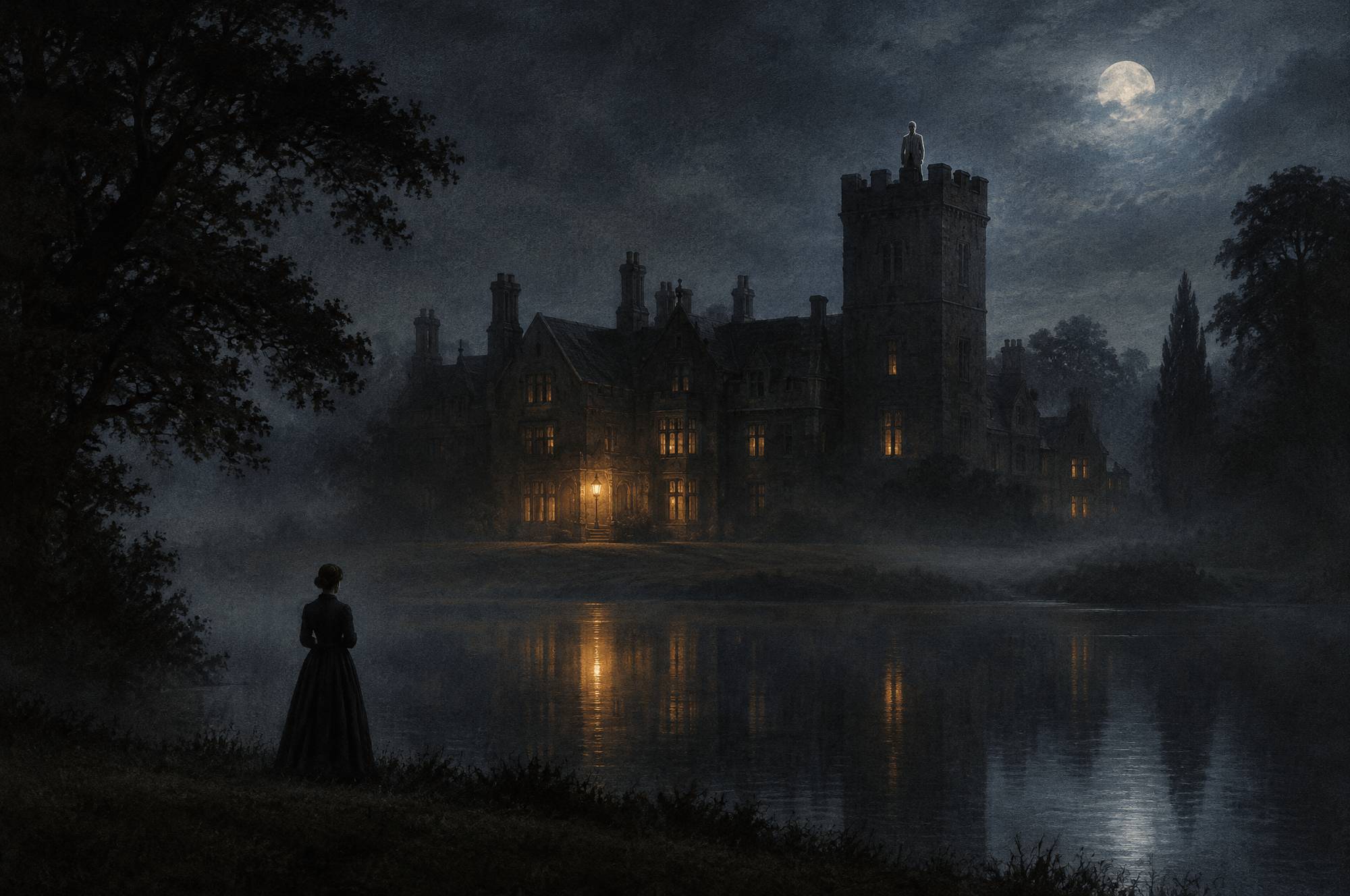
Thumbnails: Nocturne plates · illustration (AI-generated, 2026).
Alive at first appearance (Aug 1901)
Sources
- The Hound of the Baskervilles, Arthur Conan Doyle Encyclopedia. Arthur Conan Doyle Encyclopedia. Accessed 2026-10-09.
- The Strand Magazine, Arthur Conan Doyle Encyclopedia. Arthur Conan Doyle Encyclopedia. Accessed 2026-10-09.
- The Hound of the Baskervilles (ebook 2852). Project Gutenberg. Accessed 2026-10-09.
- The Final Problem, Arthur Conan Doyle Encyclopedia. Arthur Conan Doyle Encyclopedia. Accessed 2026-10-09.
- The Adventure of the Empty House, Arthur Conan Doyle Encyclopedia. Arthur Conan Doyle Encyclopedia. Accessed 2026-10-09.